
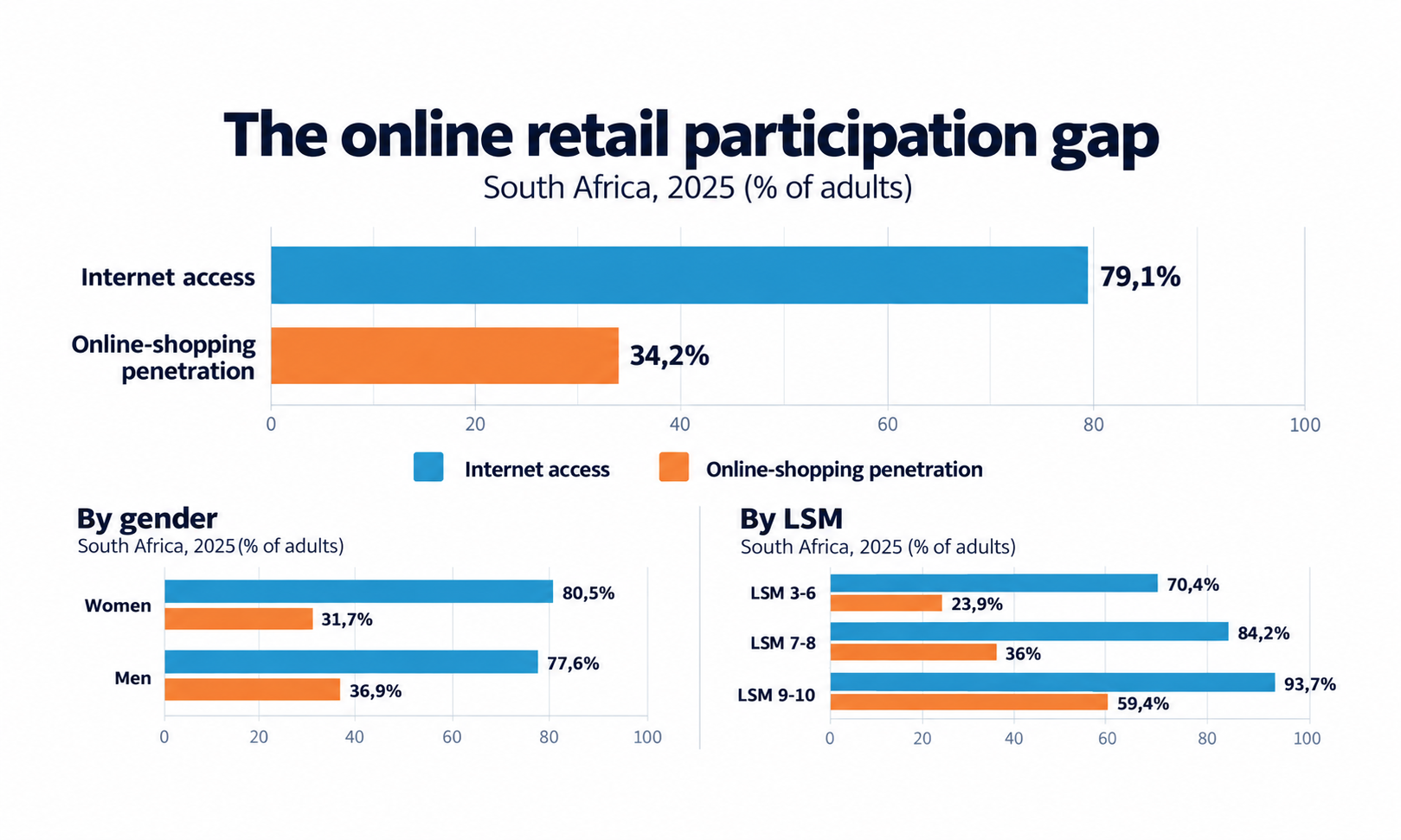
Internet access now reaches 79.1% of South African adults, yet only 34.2% shop online, leaving a large connected population outside the country’s fast-growing digital retail market.
The gap is one of the main findings of Online Retail in South Africa 2026, produced by World Wide Worx in partnership with Mastercard, Peach Payments and Ask Afrika. Consumer findings are drawn from Ask Afrika’s Target Group Index, which comprises 23,910 interviews conducted through the end of 2025.
Online-shopping penetration decreased from 36.6% in 2024 to 34.2% in 2025, despite online turnover reaching about R130-billion. The report says the decrease does not indicate a contraction in demand. Existing online shoppers are buying more, while the first customer base remains concentrated among higher-income, urban and well-connected South Africans.
Adults aged 25 to 34 record the highest age-group penetration at 39.5%. More than 60% of adults in households earning R40,000 or more shop online. Penetration reaches 75.4% in the highest socio-economic segment and 59.4% among LSM 9 to 10 consumers. Gauteng leads the provinces at 46.9%, with Pretoria at 51.2%, Johannesburg at 46.2% and Greater Soweto at 40%.
Shabir Ahmed, Mastercard senior vice president, Customer Solutions Centre Africa, says broader participation requires payment systems designed for people with different financial circumstances and levels of digital experience.
“Connectivity has placed digital services within reach of most South Africans, but access to the internet does not automatically create access to digital commerce,” he says. “Consumers need payment options they understand and trust, and merchants need tools that work across different devices, income groups and locations. Extending secure digital payments can help turn connectivity into practical economic participation.”
The participation gap is particularly wide among lower-income consumers. Among LSM 3 to 6 adults, 70.4% have internet access and 23.9% shop online. For LSM 7 to 8, the figures are 84.2% and 36% respectively. Women record higher internet access than men, at 80.5% compared with 77.6%, but lower online-shopping penetration, at 31.7% compared with 36.9%.
The report identifies delivery fees, minimum-order thresholds and unreliable last-mile service outside major urban areas as practical obstacles. Consumers also cite payment security, lack of shopping knowledge and concern that paid-for goods may not be delivered. Data costs and limited support for South African languages add to the difficulty of discovering products and completing purchases.
Payments are changing as merchants seek to reduce those barriers. The 2025 retailer survey found that 40.8% of participating retailers already offered Instant EFT or PayShap. Digital wallets grew by more than 35% year on year, while buy-now-pay-later services performed best for purchases between about R800 and R8,000.
Smartphones are used by 57.9% of online shoppers, more than double laptop use at 26%. Web browsers remain more widely used than mobile apps for purchases in 42 of the 48 categories measured, which increases the need for fast, data-efficient mobile websites as well as well-designed apps.
Clothing is the leading online retail category, bought by 36% of online shoppers, followed by groceries at 21.2%. Almost three in ten online shoppers spent R2,001 or more over six months. Convenience is a stronger motivation than price: 22.8% say convenience carries more weight, compared with 16.4% who associate online shopping with saving money and 15.7% with finding lower prices.
The security figures remain a warning for retailers and payment providers. Only 20.7% of online shoppers strongly agree that entering personal details online is safe, while 17.6% strongly agree that online purchases are secure. Concern about financial-information theft remains the most persistent barrier measured, cited by 13.7%.
Arthur Goldstuck, managing director of World Wide Worx and principal analyst on the study, says retailers would have to compete for the connected consumers they had not yet converted.
“South Africa does not have a shortage of connected consumers, but a conversion gap,” he says. “A delivery fee that overwhelms a small basket, a checkout that fails on a basic phone, or an English-only interface can exclude a customer who is already online. The next group of shoppers will be won through collection points, affordable fulfilment, accessible payments and services built for South African conditions.”
Andrea Rademeyer, CEO and founder of Ask Afrika, says the differences between internet access and shopping participation reveal where retailers are still losing potential customers.
“Women have higher internet access than men, yet lower online-shopping penetration, while the gap becomes far wider among lower-income consumers,” she says. “That tells us connectivity alone will not close the divide. Retailers need to understand the practical concerns and circumstances of these consumers before they can expect them to shop online.”
The report says store networks can help retailers address delivery cost and reliability. More than 55% of Mr Price online orders are collected in stores, while other retailers are expanding collection services and using branches as local fulfilment points. Shoprite has also extended Sixty60 into selected Shoprite stores, taking on-demand delivery beyond its original premium grocery base.
Online retail is expected to grow by about 22.5% to R159-billion in 2026. Converting more of the connected population will determine how long that rate can be sustained as the initial urban and affluent customer base matures.
* Download the full Online Retail in South Africa 2026 report here.