
Fewer than one in four SA firms trust their identity checks
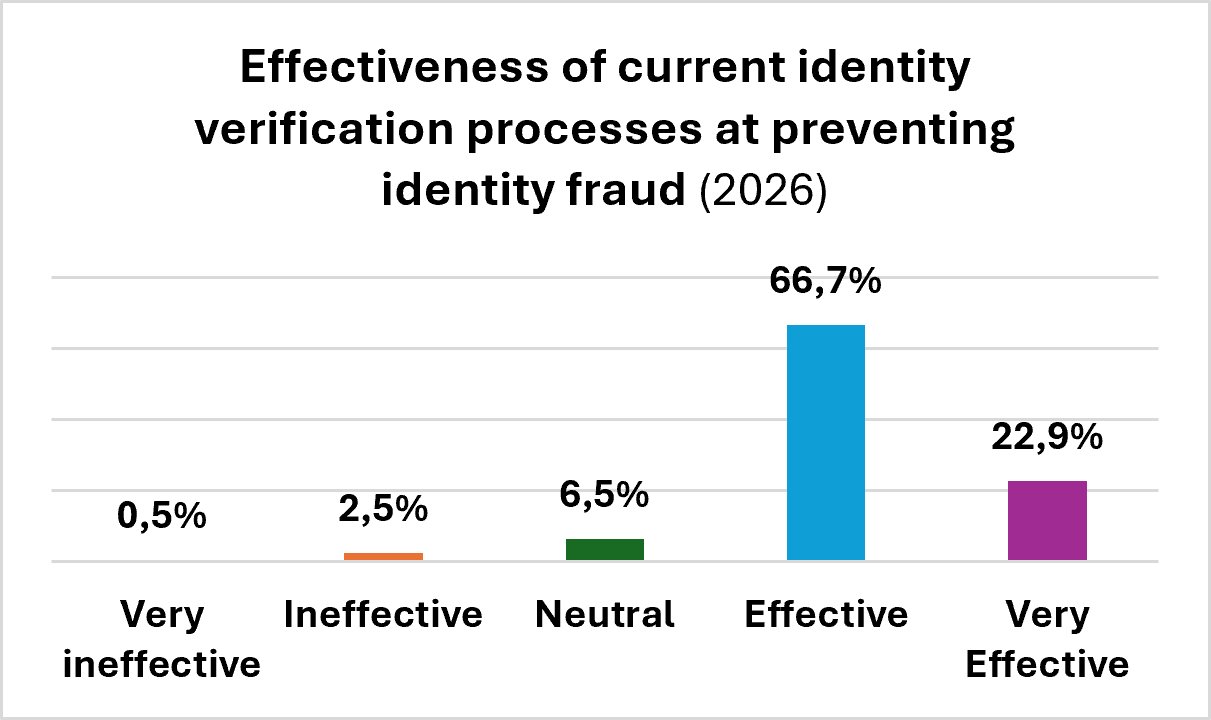
Fewer than one in four South African enterprises rate their identity verification systems as highly effective at preventing fraud. This is despite more than half suspecting or having observed attacks using AI-generated phishing, voice impersonation or deepfakes.
These are among the findings of the iiDENTIFii South African Identity Index 2026, a survey of 200 enterprises conducted by World Wide Worx on behalf of leading enterprise-grade digital identity verification platform iiDENTIFii. The proportion rating verification processes in their organisations as “very effective” has declined from 24.5% in 2024 to 22.9% in 2026.
This percentage forms the Identity Index, which tracks businesses’ own assessments of their ability to prevent identity fraud.
“Businesses are encountering fraud that puts their existing verification systems under increasing pressure,” said Arthur Goldstuck, CEO of World Wide Worx. “More than half suspect or have observed AI-generated attacks, yet fewer than half express confidence in detecting AI-assisted fraud. That gap gives businesses a clear priority for their next investments in technology.”
AI-driven fraud is the leading emerging identity fraud threat for which businesses believe they need to prepare, cited by 76.6% of respondents, up dramatically from 59.2% in 2024.
A combined 52.2% suspect or have directly observed AI-generated phishing, voice impersonation or deepfake attempts. Within that total, 18.9% report directly observing such incidents and 33.3% suspect them. Only 44.2% describe themselves as confident or very confident in detecting AI-assisted fraud.
Limited detection capabilities are the most commonly named barrier to defending against AI-driven identity threats, cited by 47.3% of respondents.
“AI gives criminals cheap, convincing ways to impersonate a customer,” said Marco Wagener, CEO of iiDENTIFii. “The question for every business is whether its verification can continuously prove a real person is present, even under the most sophisticated attack. and the only way to know is to test it against those attacks.”
Company size exposes a protection gap
Among enterprises with more than 1,000 employees, only 45.6% rate their verification processes as very effective. Enterprises with 201 to 500 employees record only 17.1%, and those with 501 to 1,000 employees record 17.8%.
“The largest enterprises are more than twice as likely as businesses with up to 1000 employees to give their systems the highest rating,” said Goldstuck. “That difference tells us that companies of every size face increasingly sophisticated attempts to exploit their identity checks, but the smaller they are, the less likely they are to be prepared.”
Just 27.9% of respondents have updated or strengthened facial liveness detection or biometric matching controls to address AI-driven or deepfake fraud. Liveness detection checks that a real person is present during biometric verification, helping protect against impersonation using fabricated images or recordings.
Synthetic identities, which combine fabricated and real identity information, are named by 66.2% as an emerging threat requiring preparation, up from 42.8% in 2024. Deepfakes are cited by 21.9%, compared with 7.5% in the previous study.
Preparedness also depends on how businesses respond when an attack occurs. Only 22.9% have formalised and tested response procedures for biometric fraud or identity compromise. A further 29.4% rely on informal processes, while 36.3% lack defined procedures.
Investment plans strengthen
The proportion of businesses planning to invest more in identity verification technology over the next 12 to 24 months has increased from 34.8% in 2024 to 54.7% in 2026.
Cost is the most commonly cited implementation challenge, at 53.7%, followed by user acceptance at 47.3%. Integration complexity is cited by 38.8%, highlighting the difficulty of adding stronger verification to existing business systems.
The report recommends prioritising high-risk uses of identity verification and introducing stronger detection capabilities in phases. Regular testing against AI-assisted fraud scenarios would help businesses assess the effectiveness of those investments.
Industry cooperation is another area requiring action. While 60.2% want better collaboration to address identity fraud, only 14.4% report frequent collaboration with industry groups, regulators or law enforcement to share intelligence and combat fraud, down from 23% in 2024.
“A trusted robust verification at onboarding can’t defend an interaction a year later,” said Wagener. “Businesses should establish trust at the moments of risk where fraud does the most damage, and then let customers reuse that trust, instead of proving who they are over and over.”
* Download the ‘iiDENTIFii South African Identity Index 2026’ report here.
ENDS
Media contacts
World Wide Worx
Arthur Goldstuck
arthur@worldwideworx.com
+27 83 326 4345
iiDENTIFii
Marelise Gilbert
+27 21 286 9104